Kanban (看板) for Software Development
The word "Kan" means "visual" in Japanese and the word "ban" means "card". So Kanban refers to "visual card", "signboard" or "billboard".
There's excellent articles describing kanban boards and methods for software development . For example InfoQ has two free e-books that are quite useful for bootstrapping kanban board.
- "Kanban and Scrum - making the most of both" by Henrik Kniberg and Mattias Skarin
- "Priming Kanban" by Jespre Boeg
But how we implemented kanban board?
I am not going to go general details covered by mentioned source. I just present some of our policies.
This board was actually used by one of our teams... Today it looks quite different but basic elements are there. Basic set of columns; Baclog; Selected; Develop; Testing; Done. And some WIP limits and avatars.
We are just installing automatic testing and staging environments and creating the separate end-user testing team. While doing, we separate developer testing and user testing to their own columns. Going away from multi-functional team, but the testing team also writes and updates the end user help documents and manuals on multiple languages while testing. And testing team will also do semi-automatic (at least minor) updates to selected production environments and pulling the tasks to final done column.
The Board
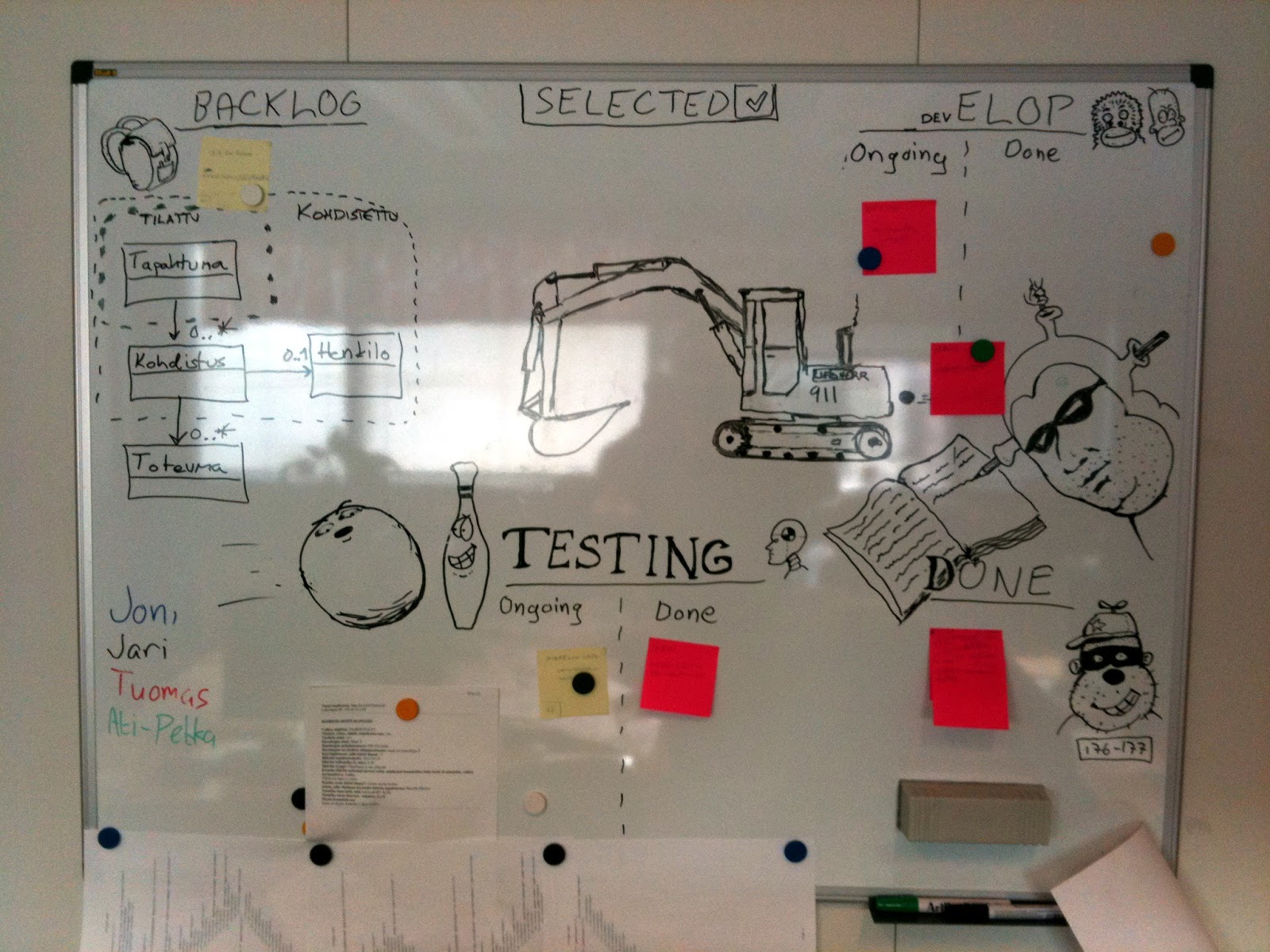 |
| The Board |
We are just installing automatic testing and staging environments and creating the separate end-user testing team. While doing, we separate developer testing and user testing to their own columns. Going away from multi-functional team, but the testing team also writes and updates the end user help documents and manuals on multiple languages while testing. And testing team will also do semi-automatic (at least minor) updates to selected production environments and pulling the tasks to final done column.
Visual Card template

Nothing very unusual here I think. Bug id is written if it exists on bug database. Harsh classification to Bug/Feature/Maintenance items. For Fixed Delivery Date (see below) items the obligatory delivery date and estimates are written to top-right corner.
Started On and Dev Done dates on bottom are for statistics and they are written on normal ballpoint pen instead of ink pen which is used for other items.
But one note; use the best sticky notes you can get. Otherwise you might end up having automatic expiration of items not handled in certain time when glue just expires. We have found that nothing compares to Super-Sticky notes from Post-It.
Class Of Service
We use quite directly the Class of Service concept from Anderson's book. Class of Service defines how items are pulled through the system. It determines priorities within the system. Currently we use 4 different levels which are visualized by color of the note. Later we are going to allocate capacity separately for different classes, but before that we can collect some statistics with just implementing the classes.
Expedite
- Red cards
- Can break WIP limits
- Only one allowed at any given time per board or swim lane
- Anyone qualified have to pull the task immediately
- No estimation unless someone specifically request it
Fixed Delivery Date
- Purple Cards
- Obligatory delivery date is displayed on top-right corner of the card
- Estimated by T-Shirt sizes
- Started in "Good Time" so that delivery time can be respected
Standard Class
- Yellow cards
- FIFO handling
- Usually no estimation unless "seems to be bigger than usual"
Intangible Class
- Green cards
- common-sense / ad hoc handling
Swim lanes
We are working on multiple products of our own with multiple projects on each product. Problem domain for products are quite different. Even that basic code base for server development is same, the context where it is used needs special knowledge for development. So we have 2-3 more or less overlapping teams. And one separate mobile development team doing parts for all products since the actual coding is completely different than server based development. So currently we have 3 different server development boards and one mobile development board. No swim lanes. And it feels quite complicated.
But at the end of the year we are moving to new office and we are already thinking whether we move to one or two boards. And maybe swim lanes to different products. Suggestions are welcomed :)
Done Policies
Current Done-policies for columns are presented in quite general terms. No point to repeat them here since there is lots of room for improvements. But we have procrastinated fine-tuning them until the next set of column changes are done. But we have noticed these policies should be visible even if all think they are well-known. It's much easier to explain the board for stakeholders and newcomers.
Things that matter most must never be at the mercy of things which matter least. -Goethe


